How Do Your Arms Stack Up to Other Gym Bros?

Note: I continue to collect data for the survey mentioned below. This post is updated as information changes.

There is an old saying that starts with “every man knows two sizes about himself” and if that man is a bodybuilder it’s a safe bet that one of those sizes is how big his arms are!

Based on the popularity of some of my earlier posts on what is the average bicep size (see When is a Man’s Arm Considered Big? and How Do You Know if You Have Big Arms? for reference) I know that this is a topic of interest for many guys out there – in fact the number one way people find my blog is because they typed “average arm size” or “average bicep size” into their favorite search engine. So, let’s presume you’ve been lifting a while now, you know how big the average bicep is and you know that you compare well to the average Joe on the street. But how big is that dude posing over in the corner of the gym and posting to his Instagram account? Do you match him? That guy looks pretty jacked…how big are his ‘guns?’ and perhaps the most important question of all: “do I have big arms?”

Let’s see if we can get some answers to allay your fears and satisfy your curiosity.

Does Size Matter?

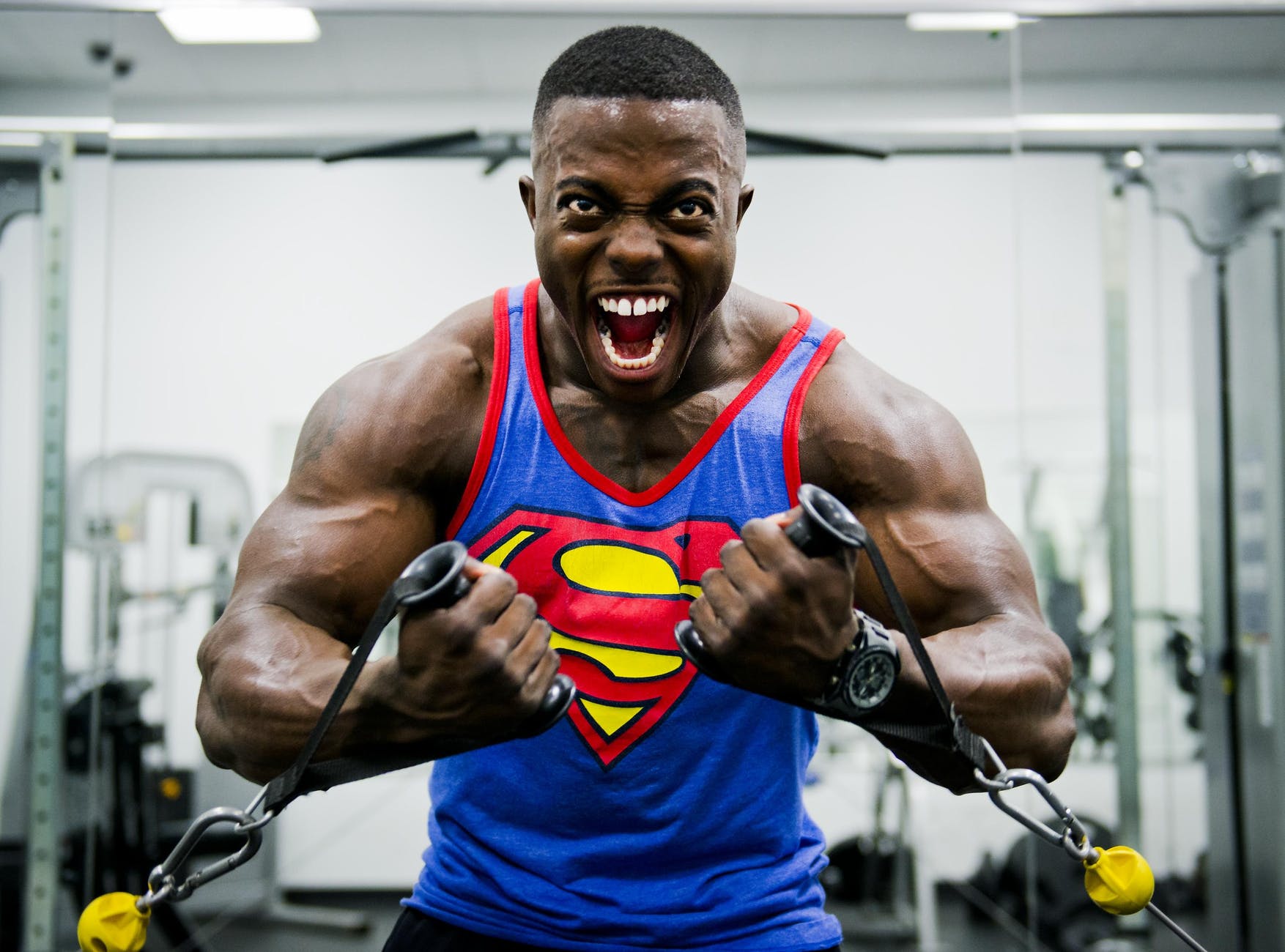
Photo by Timothy on Pexels.com

The short answer to this question is an emphatic…sort of.

It all depends what you are hoping to accomplish with your training. I’m going to go out on a limb and say that when most men start lifting it’s for one of two main reasons: 1) they want to get stronger (aka the “Charles Atlas Syndrome”) or 2) they want to look better (aka the “what ‘chu doing tonight?” syndrome).

If your goal is strength then yes, to a large degree, size does matter. But not in the way you might think. In general a bigger muscle is a stronger muscle. However, muscle size isn’t necessarily a good indicator of a man’s strength. I’ve known some 175 pound men who regularly outlift guys 50 pounds heavier. But, at some point size will be a factor. For example if a 175 pound man can bench 350 pounds he’s very strong pound for pound but has likely maxed out his capacity. Whereas if a 250 pound man can bench press 400 pounds he isn’t as strong per pound, but he’s got enough mass that he may be able to put up even more weight. It’s a matter of physics – it takes weight to move weight. There’s a reason that weightlifting competitions are divided into weight classes after all.

If, however, you are going for an aesthetic look of some kind. Perhaps to model, compete in bodybuilding, or catch the eye of a certain someone across the weight room, size does matter. You want to obtain proportions which show off your hard work in the gym and stretch your sleeves just enough to look good. But depending on your height and overall basic build you might be able to do this at a much smaller size that you think.

The Big Lie (or What to Really Expect)

The first thing you need to stop worrying about is the average bicep size of pro or any competitive bodybuilders. You don’t have to look far to find claims of exaggerated arm size which can lead to unrealistic expectations among natural lifters who are just starting out. Any bodybuilder worth his salt is going to claim that he has an arm which measures 20 inches (51 cm) or more. Arnold Schwarzenegger, for example, claimed he had a 22″ (56 cm) arm at his peak at a lean bodyweight of 235 pounds (107 kg) and a height of either 6’1″ or 6’2″ (187 cm).

However, even for one of the greatest bodybuilders ever, an arm that size is unlikely. I’m not saying that arms this big don’t exist, as I personally know a bodybuilder who has 20″ (51 cm) arms. But he is admittedly not natural and that measurement is flexed with a pump. To be frank, arms that big usually belong to men with high bodyfat percentages so they appear flat and without shape. Which in part defeats the goal of having big arms -which is to look and be strong.

The sad truth is that despite what you see on the internet or read in the muscle magazines (do they still have those?) you are not likely to get to a true 20″ arm with out extraordinary genetics and chemical assistance (prove me wrong guys – and more power to you if you do).

So, having said all this what can you expect. That’s were my recent survey came in.

Collecting Data

Photo by Andres Ayrton on Pexels.com

Getting some basic information on the arm size of guys who lift for non-competitive reasons was a little difficult. This is in part because apparently hanging out at the men’s locker room of the local Planet Fitness with a tape measure in hand is not only frowned upon, but can even get you a lifetime ban from the place (don’t ask how I know)! These left me to approached men I know in real life and through social media and ask them how big their arms are. To my surprise, most agreed to help out as they were curious, too.

I want to stress that my survey is unscientific. To my knowledge all the participants have lifted for at least five years and some for considerably longer. Weightlifting and bodybuilding is not necessarily their primary athletic activity at this time, but it is included in their regular workouts. A few of the participants are actively trying to build their arms up (6), some are trying to maintain size (3) and the others are just lifting to improve/maintain their health (6). My sample group, though I think diverse, currently only has 19 men in it.

Testing Conditions

For the reasons stated above, all measurements were self-reported by the participants. There was no consistency in measuring tapes or techniques. The men range in age from 21 years old to 61 years old – but age is not factored into my results. The tallest are 6’3″ (190.5 cm) and the shortest is about 5’5″ (165 cm). I did not factor in weight, bodyfat percentage or other bodily measurements such as chest and waist. However, to my eye at least, all can be considered muscular even if a few are rocking the so-called “dad bod” or, in my case, the “grandad bod.” Most are Americans, but because I was able to gather information through social media some of the participants are men who reside outside of the United States.

Most of the men had a large arm and a small arm. For the purposes of this survey I took the larger arm’s measurement. Four of the men mentioned specifically that their arms had been larger in the past but they had lost size during the pandemic or for other reasons.

Most importantly, to my knowledge, most are “natural” athletes who take nothing stronger than protein powder and pre-workout. I did not ask about the use of PEDs (performance enhancing drugs) though. These are just regular guys who lift on a regular basis. It’s intended to be a random sample of who you might meet in a typical gym and, let’s face it, in today’s culture you are likely comparing yourself to a couple of guys who are juicing but you don’t know it. Okay, I’ve got a couple ringers in my sample group who were once elite athletes and a couple personal trainers who lift for a living.

The Results

Photo by Pikx By Panther on Pexels.com

Let start with the numbers rounded to the nearest quarter inch or half centimeter:

  • Average Height – 70 inches (178 cm). Yes, they are a relatively tall group.
    Median Height – 70 inches (178 cm). Seven men are 5’10” exactly and make up the most common height. The next most common height it 5’11” (180 cm) with three men this tall.
  • Average Arm Unflexed – just under 15 inches (38 cm).
    Median Arm Unflexed – 15 inches (38 cm).
  • Average Arm Flexed – 16.3 inches (41.4 cm)
    Median Arm Flexed – 16.25 inches (41.3 cm)

Average Difference Between Flexed and Unflexed Arm – just under 1.5 inches (3.8 cm). Median difference is 1.5 inches exactly (3.81 cm)

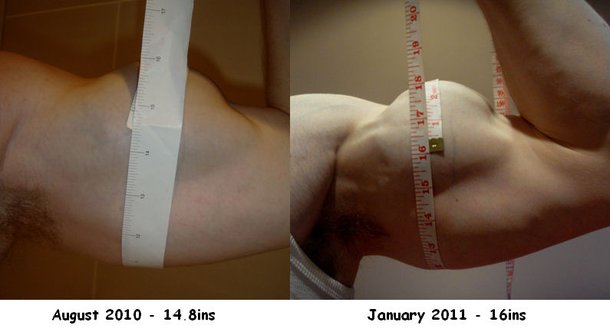
I threw the last measurement between the flexed and unflexed arm in for fun. Remember, when an arm is flexed the volume of the muscle doesn’t change, just the shape of it does. It’s my understanding that the difference in size between a flexed and unflexed arm can be an indication of how much fat is in the arm because you can’t flex fat. This is not true with the very lean man but may be true for those of us with a more substantial BMI. I’ve noticed myself that the leaner I get the greater this difference becomes. My difference is 2 inches (5 cm). The largest difference in the survey was at 2.5 inches (6.5 cm) and the smallest at a half inch (1.3 cm) which oddly enough was on a man who I know is very lean.

So what can we learn from the above information? I think the obvious take away is that if you lift you can expect your arms to get to at least 16 inches (42 cm) at a minimum regardless of height. Interestingly enough the tallest men in my survey, who were both 6’3″ (190.5 cm) did not have the biggest arms. That honor belonged to a man who stands 6’1″ (185.5 cm) with 18.25 inch (46.5.cm) arms. Likewise the shortest man at about 5’5″ (165 cm) had arms an inch larger, at 16″ (41 cm) than men 6 inches taller than him! However, in general, the men over 6 feet tall had larger arms. This probably shouldn’t be a surprise as a bigger skeleton has more room for muscle to grow. Even though overall proportions may make that taller man look leaner at a technically larger size than the shorter guys.

And before you get concerned that a 17 inch arm is too small – go read my blog post on when is a man’s arm considered big that I mentioned earlier. You’ll find out that the average non-lifter’s arms are much smaller. By several inches!

Conclusion

To sum everything up, it’s better to go for an arm that looks big than one which is actually big. Especially if you happen to be under 6 feet tall. Any man who is sporting a muscular arm that measures 16″ (41 cm) or more can consider his arms to be big. And likely, so will everyone else!

Stay lean, focus on the triceps as much if not more than the biceps, and you’ll be getting second looks because of the size of your “guns” soon enough. Tall guys, the good news is that you can likely build arms which exceed those of a man who is shorter. But, bad news, if you are like most of the tall men I know at least, you’re going to have to keep pushing on to 18″ (46 cm) to look really big. And remember, the true 18″ arm is rare.

If you need some tips on building big biceps check out another one of my blog posts The Secret to Building Big Arms Which No One Else is Willing to Share.

Well, what are you waiting for? Stop flexing in the mirror and go get lifting!

P.S. – do you want to participate in this survey? It’s not too late. Just comment or message me with your stats and I’ll add them into the sample group.

P.S.S. – want to know how your chest stacks up? Go to When is a Man’s Chest Considered Big.

All photos by David P. Wahr unless otherwise noted in which case the original artist retains all rights. Otherwise photos and words @copyright by David P. Wahr

Why We Run

A Very Brief and Oversimplified History of Running

Sometimes the first mile is the hardest.

Running as a sport has been around a long time – at least going back to the ancient Greek Olympic games and possibly even older. Early on running served the practical purpose of conveying messages relatively quickly between communities and military forces, at least if the legend of how the marathon came to be is true, and then later it became something that people did for fun.

To my memory running and jogging as a hobby really took off in the 1970s in large thanks to people like Jim Fix, whose book The Complete Book of Running is credited by some as kicking off the entire fitness “craze,” and Thaddeus Kostrubala who wrote the Joy of Running. Because of these two men and other fitness gurus at the time millions of people discovered the health benefits of running as a way to increase cardio vascular health and lose weight. It was no longer something that only boxers did in the movies during a training montage.

Running For a Cause

At the same time that running for hobby was gaining popularity it also became linked with raising money for causes. One of the most famous causes that comes to mind is Terry Fox’s Marathon of Hope in 1980. Fox attempted to run east to west across Canada run to raise money and awareness for cancer research. And this after his own leg was amputated from the disease! Although the spread of his cancer eventually forced him to end his quest after 143 days and 5,373 kilometers (3,339 mi) his legacy lives on with millions of people around the world running in his honor annually while raising funds for cancer research.

Other groups followed this lead and it became a trend. Today on any given weekend you can likely find any number of 5k, 10k, half marathons, or full marathons benefiting a worthy cause near your home.

There is no doubt that running has become a powerful tool to raise awareness and funds for various causes world-wide.

Why Running?

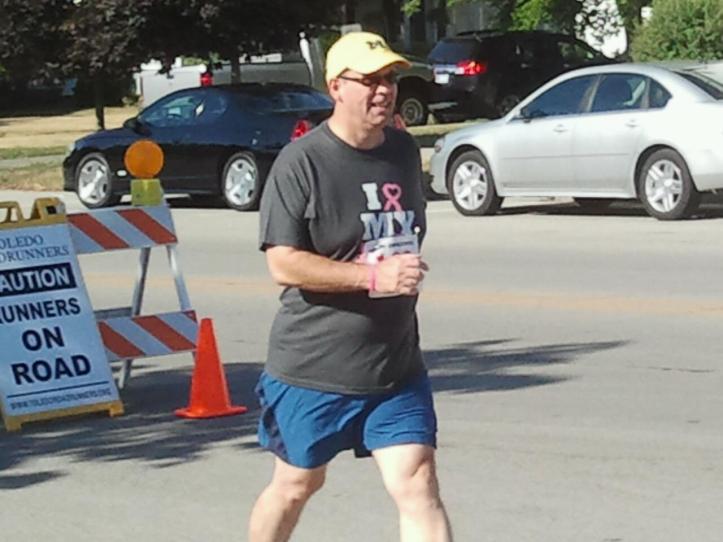
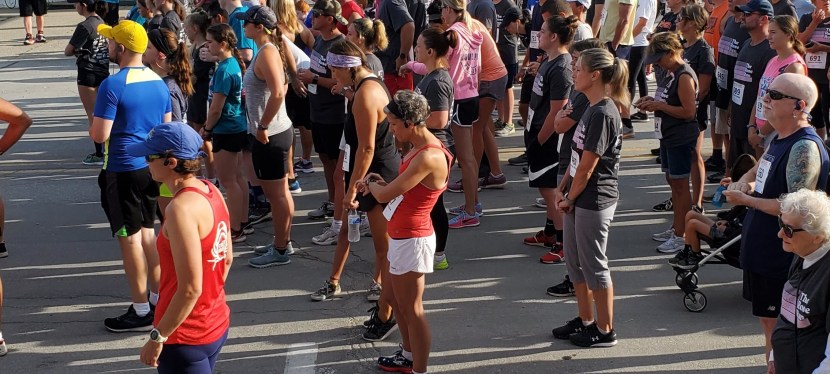
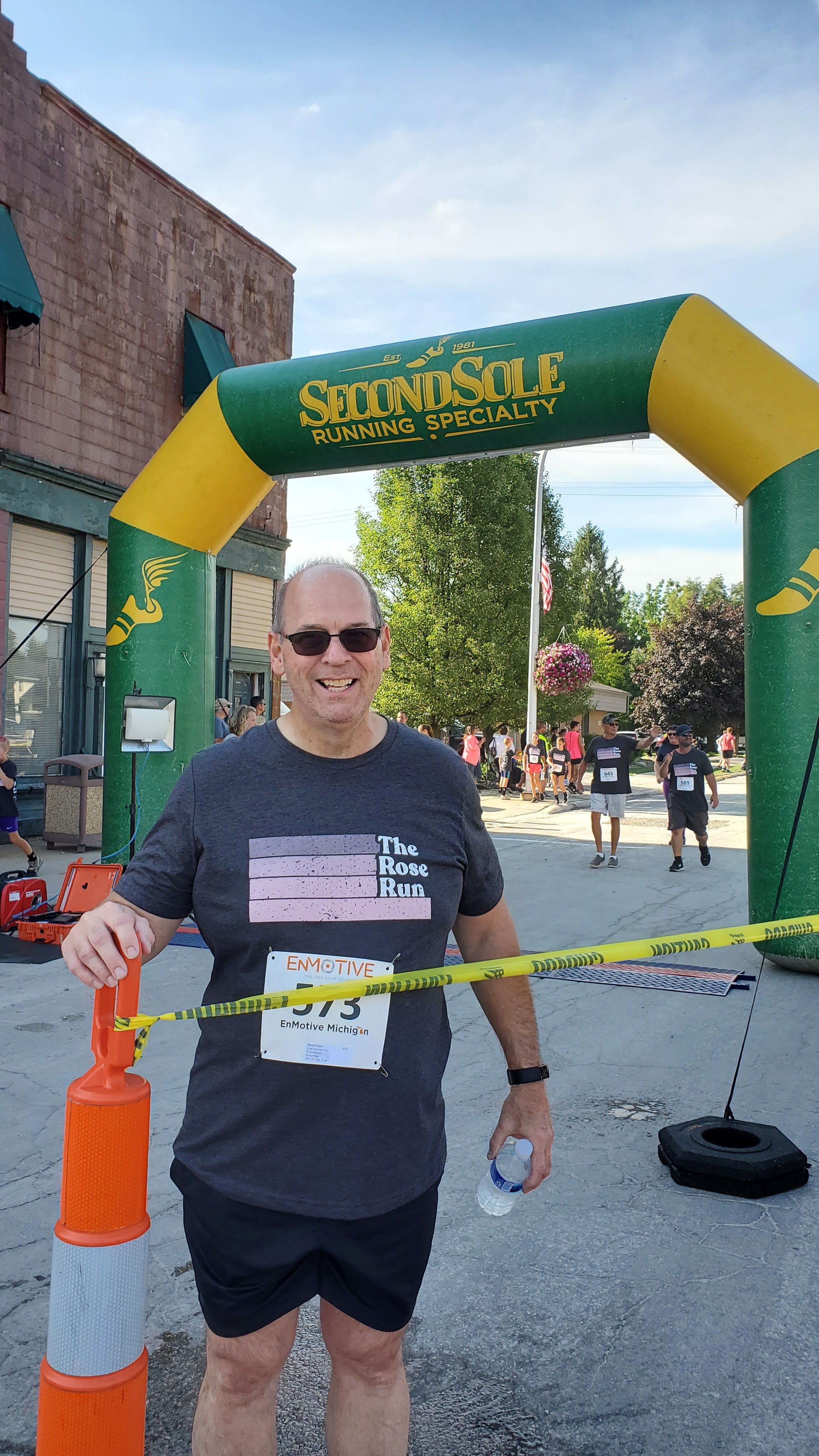
So when answering the question, “why do we run?” I think that on the surface there are several obvious answers: health, sport, and fundraising. I myself participate once a year in a 5K run in my hometown which benefits breast cancer research: The Rose Run. Interestingly, this race is run both in the little City of Petersburg, Michigan (pop. 1,200 or so) and in Burbank, California (pop. a whole lot more). I get a kick out of that for some reason.

However, even though I do not consider myself a true runner by any stretch of the imagination – unless a bear or another large carnivore is chasing me so if you see me running you better start running, too – I can tell you that it isn’t any of the obvious reasons which keeps people running. It’s deeper than that and some of the reasons are conflicting believe it or not.

Here’s my list of the real reasons people run:

Alone Time: just you, some tunes on the phone, and nature. What a better way to get out doors and clear your head of the days worries and troubles or just to think.

Camaraderie: there’s a certain friendship among runners. This is similar to the instant connection most everyone has when they meet another person who engages in the same hobby/sport that you do, but it seems especially strong among runners.

The Joy of Participation: I had the pleasure of running in this year’s Rose Run with my niece. Our shared experience over that 5K has given us stories that will last for weeks and memories that will last much longer.

It Feels So Good When You Stop: not just because you can breathe easily again and your heart slows back down to a reasonable pace. Once those endorphins kick in you really do feel better and happier!

Satisfaction of Pushing Yourself Towards a Goal: there’s a certain satisfaction that we all feel when you set out to achieve a goal and then go out and do it. Whether it be 5K or a full out marathon – you can deservedly pat yourself on the back. Even if you have to soak your feet afterwards!

So that’s it. My real reasons we run. I’d love to hear what yours are – leave a comment and share!

Finished the race and I’m still smiling!

All photos by David P. Wahr unless otherwise noted in which case the original artist retains all rights. Otherwise photos and words @copyright by David P. Wahr

Fitness Quest: July 2021 Update

Since we are now about half-way through the year and I haven’t done a proper fitness update in a while here you go!

Internal Health

The big news is that my Crohn’s disease continues to be under control. The bigger news is that my heart is working better, too. There was a concern in March that my heart function had decreased somewhat so my cardiologist put me on Entresto (you’ve seen the ads if you live in the United States) and it appears to be working. My ejection fraction has gone from 35% to 43% in the first three months. Since I tolerate the drug and am responding to it we are now talking about increasing the dosage a little to see if we can do a little better. From what I understand a normal ejection fraction is somewhere between 70 and 50%. So I’m almost back to the “normal” range. An unexpected side effect is that I could tell it was working because I didn’t have so many dark thoughts about death and dying as I’ve been having since this whole thing began. I’m thinking about the future again. The mind and the body are linked. If your body works better, your mind responds accordingly. At least that seems to hold true in my case.

External Health

I’m still staying active as possible and, according to my trainer at least, I’m doing things that men 20 years younger than me can’t do. Such as bench press more than my bodyweight. My weight is down since the beginning of the year and I see veins where I haven’t seen veins before (if you don’t know why this is cool, talk to your nearest gym rat). I’ve given up on ever having six pack abs for the simple reason that two abdominal surgeries have kind of mooshed things around. I’m still working on losing the layers of fat on my mid-section but between the scars and other issues I don’t know what I’ll find when that happens. Still a long way to go but my bodyfat is moving downwards with my weight.

Current Workout and Activities

Cardio will be a bit of a challenge as usual. My tap dancing is paused for the summer (we’ll start up again in September) and I need to get back to putting in my steps each day. I’ve been falling short of my 10,000 for quite a while now.

Like men 30 years my junior I’m still obsessed with arm size. So I’m in a little competition with another friend who lifts to see who can gain the most size on his arms in six weeks. In addition to this I am working chest twice per week and am currently going with a high repetition/low weight scheme on bench press. I’m working up to 100 reps over 4 sets at 135 lbs. (61kg) with my brother-in-law. I’m about 10 shy of the goal right now. Not sure what we’ll do next. Maybe back to 225 lbs (102kg) to see how we fare at that weight. I also workout with my trainer once per week.

I’ll be running – and I use the term loosely – in the annual Rose Run on July 10th which is a fund raiser for cancer research. I’m also doing a 25 push up per day challenge for the American Cancer Society. So it’s a busy month!

Summary

If I can keep up this pace I expect to end the year in a much healthier place than I began it. And with a more positive mindset, too. I don’t expect to win any marathons or bodybuilding competitions, but I sure as heck expect to be wearing smaller pants and lifting more weight! I might even be a better tap dancer too. A long shot I know.

I hope that you are all doing well in overcoming your fitness challenges and reaching your goals, too! Let me know about them in the comment section below.

Featured image by Photo by Victor Freitas from Pexels

All photos by David P. Wahr unless otherwise noted in which case the original artist retains all rights. Otherwise photos and words @copyright by David P. Wahr
Fitness Quest: Healthy Aging

Someone once, I can’t remember who, described aging best: you’re old when you drop something and you have to decide if it’s worth bending over to pick it up or if you can learn to live without it.

This observation seemed like a funny joke when I first heard it, but today it strikes a little too close to home. I don’t know about you but every day I wake up with some new little snap, crackle, or pop and I don’t mean in my cereal bowl! The sad truth is that time has a way with catching up to all of us sooner or later and no matter how we fight it we have to admit that we might be just a little bit past our prime as we enter our golden years (not that I’m there yet *cough*).

The problem as I see it is that most of us surrender to the inevitable way, way too soon. There are reports that for each decade past the age of 30 that men will lose between 3 and 5% of their muscle mass resulting in a loss of 30% of their muscle in their lifetimes (compared to their twenties). Moreover, there are also studies that show most people will also gain 1 or 2 pounds a year at the same time. Why? Well, no doubt some of this is because of the natural aging process. But I maintain it’s also because at some point in their youth most people just decide that it’s not worth the effort to stay fit anymore. They sit down in front of their TVs, laptops, tablets, phones, whatever and just don’t get up. Maybe it’s because of some pain or stiffness in the joints. Maybe it’s just because they feel tired all the time. Maybe it’s just because of <insert reason here>. Maybe it really is because of some serious medical condition – but I’m guessing that if you are still reading this that it’s not in your case and you are really looking for the key to staying healthy longer. Well here it is: exercise.

Now, I’m not saying that you have to workout like a pro-athlete or get up and run marathons several times a year (though you can if you want). I’m suggesting that even a moderate amount of movement each day, along with a little weight bearing exercise (body or actual weights) can help you maintain strength, balance, and keep those pounds off as you get older. Along with a healthy diet, of course.

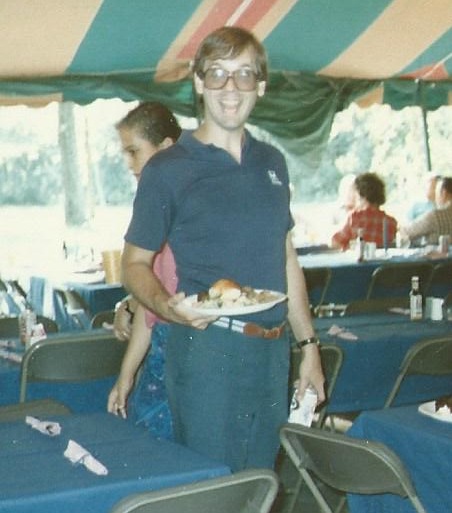
Skinny me in my twenties!
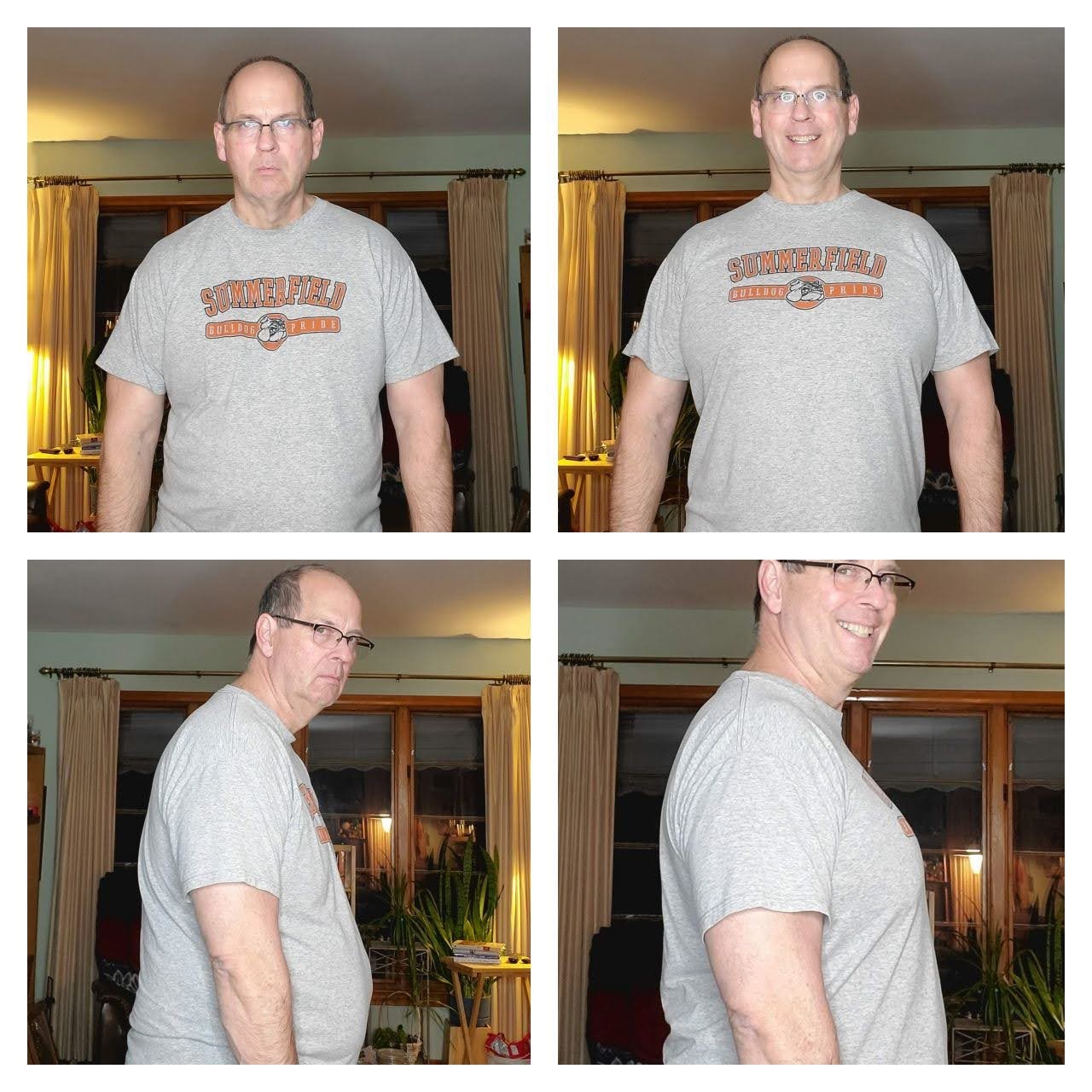
Not so skinny me today. Yes, there’s still some muscle under the fat.

I’ll use myself as an example. Based on photographic evidence I was always a fairly skinny guy through my teens and into my twenties. At one point after my Crohn’s revealed itself I only weighed about 130 – 140 pounds for a while at a height of about 5’11”. However, over the course of my thirties and forties instead of losing muscle mass as the experts would predict I nearly doubled my bodyweight. Certainly, a lot of my mass gained was fat but I also increased my strength from bench pressing 95 pounds (43 kg) to a 1 rep max lift of 350 pounds (159 kg) in my late forties. In other words, at an age when my strength should have been declining, thanks to regular exercise my strength increase more than threefold.

Even today, though I don’t lift heavy to protect my joints, my 1 rep max lift is calculated to be at about 315 pounds (143 kg). Okay, I just said that to brag since it’s a decrease in strength over the past decade it doesn’t really support my overall point. Going on…

Now I may not be the best example, because thanks to Crohn’s I was not at full strength for a good chunk of my twenties or even good health. The onset of my disease did set me back a fair amount and I lost gains that I had made earlier during college. Not that I was a beefcake before Crohn’s reared it’s life altering head. But my point remains, instead of losing muscle over the next twenty years I gained muscle through regular exercise. Likewise, my regular training partner, who did not suffer from the same medical conditions and setbacks I did, also gained muscle and strength during this period. To me we are both examples that the “ravages of time” can at the very least be slowed down if not out right reversed through regular weight bearing exercise.

And it’s never too late to start. Studies have shown that people in their seventies, eighties and beyond are capable of gaining muscle and strength with just moderate weightlifting. Now granted as we age our joints maybe can’t take the strain of very heavy lifting and certainly recovery time is greater. Even I have to admit that I’m unlikely to be able to win the title of Mr. Olympia no matter how hard I train or even become a social media fitness model (shocking, I know). But I do know that if I fall down I have the strength to get up and, more importantly, I have the strength to squat without having to use the handles in the handicap stall in a public restroom. Practical strength is valuable as we age – trust me. Also, bonus, weight bearing exercises also keep your bones strong.

Even if weights aren’t your thing, there is value in just getting up and moving each day. Take a brisk walk, do some yoga or stretching, find some way to move. This will improve your cardiovascular system and balance, too.

Exercise alone doesn’t solve every issue of aging. Arthritis and other issue will likely cause your joints to ache. As I age I find I have to pay attention to other things, too. Diet, obviously, and also posture. Years of spending my days hunched over a computer keyboard have taken a toll. Both in terms of stiffness in my shoulders and in what is now sometimes called “nerd neck” (really). It may take some effort to get back into the habit of standing tall, gut in, shoulders back, chest out, but it’s worth it in the long run.

Good posture can make you look better and feel better – even as you get older!

Sadly, there are no guarantees in life and exercise isn’t a panacea for all conditions. The reality is that you can do everything right and still get sick. Take me for example, as I mentioned earlier I have Crohn’s disease. This condition, which is of unknown origin still today, may have been partly responsible for the heart attack which damaged – and continues to damage – my heart. I suffered a bowel perforation from the damage that Crohn’s did to my intestines, which resulted in me becoming an ostomate for several months. Though the surgery saved my life and I’ve been “reconnected” my digestive system doesn’t work at peak performance. I’m incapable of absorbing nutrients as well as I did prior to the surgery which could have a long term impact on my health. I was hospitalized with Norovirus which was likely picked up because I likely ate food that someone who didn’t wash their hands properly had prepared. This caused extreme dehydration and my kidneys even shut down so they don’t work as well as they used to now. I had a blood clot in my leg (deep vein thrombosis aka DVT). I have to sleep with “life support” – a CPAP machine – due to central sleep apnea which causes my brain to forget to tell my lungs to keep breathing, and so on and so forth. No matter what you do you are likely going to have problems as you get older.

You will also likely consider shaving your ears but that’s a topic best left for another blog entry.

I strongly suggest that you start moving more as soon as possible. Obviously, consult with your medical care team (and if you’re older you probably have a team of doctors) before beginning any new exercise program. However, I have often said that the moment you stop moving is the moment you become old. It’s as simple as that.

The thing to remember, no matter how tough aging can be, is that we are among the lucky ones. Many people haven’t made it to our age (whatever that may be). Each day is a blessing and we should make the most of every single one. None of us knows how long we have on this Earth, but with a little self-care the chances of those remaining days and years being enjoyable increase considerably.

As the saying goes, old age isn’t for the timid. They also say only the good die young. So do yourself a favor and give your bad self some exercise!

All photos by David P. Wahr unless otherwise noted in which case the original artist retains all rights. Otherwise photos and words @copyright by David P. Wahr

How Do You Know if You Have Big Arms?

Photo by Andrea Piacquadio on Pexels.com

There is a saying in most gyms that, for men at least, “the day you first pick up a weight is the day you become forever small.”

Like many sayings there seems to be some truth in it. In fact, I will go out on a limb and say that every man who starts to lift weights is doing it because at some level he wants bigger muscles. Oh sure, he might start with the idea of getting stronger for sports or maybe it’s because he is getting picked on for being too skinny (or too fat) or because he thinks it will help him get noticed by girls or any of a dozen more reasons. But, at the basic motivation level, he wants to be able to roll up his shirt sleeve and have something to flex. Or better yet, something to flex that will stretch his shirt sleeves without rolling them up.

This isn’t an issue just for American men. If my most popular blog post – When is a Man’s Arm Considered Big? – is any indication this is a concern for men all over the world. Nearly every guy who has done a barbell curl and made some gains has measured his arms and thought “do I have big arms?” I’ve had hits from every continent (except Antarctica) and most every country. Some even from real people!

Go to social media or your favorite search engine and you’ll find that building bigger arms is a popular subject for literally thousands of Instagrammers, YouTubers, Facebookers, and I suspect Tik Tokkers too. Even men with extraordinarily big arms will talk about how they want to add just a little more “size to the bis” with the usual goal being a muscular 20 inches (or a little over 50 cm). Which, frankly, is unrealistic for most men and difficult to achieve even with vitamin-S (steroids).

Me as a “fat” teen. Photo from my high school yearbook.

“But wait,” you say, “don’t guys who are jacked know that they are jacked?” No, they don’t always know. Obviously a few do and they are eager to capitalize on this (again go to social media – you’ll find plenty of them willing to sell you a training program). But for most of us “average Joes” it’s a constant battle to gain a little more size and shape. Because no matter how developed we become there’s always the same skinny/fat guy looking back at us in the mirror.

Many people joke that bodybuilders and weightlifters – but never crossfitters for some reason (zing!) – suffer from body dysmorphia. I’m not going to go that far as true dysmorphia is a serious mental health disorder that can lead to significant issues. But I do think that as a group the bodybuilding community may suffer from what I’ll call a physical “misperception.” It’s no secret that in a way we are all two different people. We are the person who the world sees and also the person who we see inside our head. Moreover this inner perception of ourselves is often formed when we are young and difficult to change. If you were skinny as a kid, your self-image is one of a skinny kid. I myself always thought I was fat as a kid but pictures from my youth clearly indicate that this was never the case!

Photo by Pixabay on Pexels.com

From my own personal experience regardless of how big or small my arms have been over the years – from stick thin (thanks to my Crohn’s disease) to flat and fat (thanks poor diet) – in the mirror I always see the same somewhat shapeless, flabby arm. Even when presented with external evidence to the contrary.

For example, here are a few comments I have gotten about my arms over the years:

  • “Wow, you have big triceps,” from an EMT helping to remove my sweatshirt in the Emergency Room (long story told here).
  • “You have big triceps,” a friend making casual conversation at a party after asking if I had been working out.
  • “You must workout,” from a phlebotomist about to take my blood.
  • “Don’t go breaking my blood pressure cuff with those muscles,” a medical technician during a pre-exam. Yes, in case you noticed, many of the comments I get about my arm development come from medical professionals.
  • “At some point your arms just kind of blew up like…(making a motion that indicates the size of a basketball),” a friend who was commenting on my weight room progress.
  • “You think your arms are small because you can’t see your triceps,” from a training partner.
  • “Looks like someone brought the big guns out tonight,” a crew member taking my ticket while I was boarding a boat for a dinner cruise (I was wearing a short sleeve shirt with admittedly tight sleeves).
  • “Oh come on, make a muscle,” a female friend at a party. I put this one here because all the other above comments were from men – so much about bigger muscles attracting women (sorry guys).

Interestingly enough, I got many of these comments when my arms were not at their biggest. Why? Because a fat arm doesn’t necessarily look big. Especially if it matches the rest of the body. Without definition and a visible “peak” to the bicep or “horseshoe” to the tricep the assumption is that there is no muscle underneath. A man with 18″ (46 cm) arms, which are big in anyone’s books, at 35% bodyfat may therefore look smaller than the man with a 16″ (41 cm) arms at 15% bodyfat. In this case size does not actually matter. The perception of size does.

So, if a big arm can look small and a small arm can look big – how do you know if you have big arms?

Simple, other people will tell you.

Now go hit the gym. It’s arm day!

P.S. – do you want to know how your 16 inch arms stack up to the average guy or your fellow gym goers? Find out here and here! Want to build bigger arms? Here are couple tips.

Photo by Cesar Galeu00e3o on Pexels.com

All photos by David P. Wahr unless otherwise noted in which case the original artist retains all rights. Otherwise photos and words @copyright by David P. Wahr
Fitness Quest: 2020 A Year in Review

Well, I’ve been away from this blog for far too long! I’m sure that both my fans have been wondering what I’ve been up to fitness-wise so here it is: not much.

I don’t have to tell anyone that 2020 was, at best, a weird year. For me the biggest adjustment was working mostly from home and I acknowledge that I’m fortunate to be able to do this. The other big adjustment was not being able to travel as I normally would. So you might think with all of this unscheduled free time being given to me because my normal after work activities being halted, especially community theatre as the biggest “time hog,” that my focus on fitness would have skyrocketed and that by now I’m a mass of lean, mean, old man muscle. Well, not so much.

The toys.

Gyms closing didn’t help but that wasn’t the real issue. My biggest issue was adjusting to cooking at home. Which, if done right, is the way we should all go. However, I found that when confronted with a full refrigerator and pantry all day I tended to “graze” all day in addition to my regular meals. So like so many others my weight creeped up during the past nine-months but went way up starting about July according to my fitbit. I think the combination of eating all day and the loss of my regular cardio classes just finally caught up with me despite my regular walks. I also suffered a mysterious shoulder injury in September so my lifting was impacted. My bench press in particular. I did manage to continue weight workouts with the personal trainer in his home gym and with my brother-in-law in his. The spring, summer, and early fall saw me taking regular walks with my sister mostly every night. But the extra fat has refused to budge.

Photo by Rachel Claire on Pexels.com

So, in an effort to make a change I’ve given into the marketing and am trying Noom. I have plenty of suggestions on how to improve the product which might be worthy of another blog entry after a few more weeks, but so far so good. It’s helped to remind me of things I already knew and I’m down about four (4) pounds so far (almost 2 kg).

Things I did discover while cooking for myself this past year – I do like a fairly wide variety of foods. The heart healthy Mediterranean diet is interesting and not that hard to make. Vegetables and fruits are filling and also tasty. Don’t get me wrong, hamburgers and fries are still a big portion of my diet (too big) but I do see the way and the light. Plus one of my new past-times is looking through cookbooks and thinking to myself “I can make that.”

The biggest news – I got through 2020 without a major health crisis! No ER visits, no surgeries. The Stelara I take to control my Crohn’s seems to be working and my gastroenterologist says that there is no sign of the disease. This means that, for the moment at least, I should be able to become as fit as my middle-aged body will let me. Yes, I still have a damaged heart from a previous heart attack. Yes, my kidneys are still below optimal function from my bout with Norovirus last year (did you forget that their are still other viruses out there waiting to get you? Keep washing your hands and covering your faces folks – thanks) but overall I’m stable and healthy. Minus a few occasional aches and pains. Also, I find it ironic that I can lift a small car off my chest if necessary (a very small car) but have trouble getting up off the floor. It’d be funny if it weren’t so true.

So, I’m done with 2020 and ready to move on to 2021. I can’t control what the world may have in store for me, but I can sure as heck control how I react to it and my own small corner of it.

Onward!

Fitness Quest: 2019 A Year in Review

It may be a couple days late, but at the start of another year I think it’s worth taking a quick look back at where I’ve come fitness wise at least. One of the benefits of keeping records is being able to see progress which in real time seems to never come.

I started 2019 as an ostomate. I’ve discussed this in other blogs (like this one here). Suffice it to say that there are challenges when you don’t have use of your colon. Among them was getting the proper nutrients and maintaining weight. In some ways this was good as I did lose a good deal of fat through the experience but also lost muscle as well.

Giving the “thumbs up” after surgery!

I am fortunate that my ileostomy could be reversed and was in April 2019. The results were immediate, observable and positive. Muscle gains, despite being a middle-aged man, were rapid as my body started bouncing back to it’s old self. To the point that my trainer was impressed and even asked if I had always put on muscle so quickly (I wish). By the end of the year I had gained about 30 pounds and according to skin fold measurements almost all of it was lean mass.

Briefly, I started the year weighing 196 pounds/89 kg with a bodyfat % of 24%. I ended weighing 226 pounds/102.5 kg with a bodyfat of 23.5. Even given the usual error rate a significant gain in solid mass (skinfold totals dropped from 151 to 137). My chest grew from 39.5 inches/100.3 cm inches to almost 45 inches/114.3 cm. My unflexed arms are the same size (about 13.5 inches/34.3 cm) but flexed I stretch the tape to nearly 16 inches/40.6 cm, a gain of about 1.5 inches/3.8 cm.

Me putting on a good face during the annual Rose Run in Petersburg, MI

Cardiovascularly, even though I didn’t beat my best time in my annual 5K run I did better than I have in most years. My blood pressure has crept up this year so I need to refocus on my diet – especially my sugar habit – and get more regular with my cardio. Though I do a couple cardio and core sessions each week I’m not getting my steps in now that winter is here. I’m making better use of my exercise bike since last week and will have to keep it up.

Foods we should all eat more often!

My diet has changed. I’m cooking more food myself at home and packing lunch almost everyday. I wouldn’t say I’m on a true mediterranean diet by any means, but I eat more olive oil, hummus, and vegetables in general than I ever thought I would. Plus, even though I visit the drive-thru much too often (2-3 times per week) this is about half as often as I used to do.

I do take a lot more selfies these days, too!

For 2020 I’ve got the usual goals – increased cardiovascular health, less fat and more muscle. If the past year is an indication I like my odds.

Onward!

The Secret to Building Big Arms Which No One Else is Willing to Share Is…

If there’s one thing that I think we can be sure of is that most guys who start lifting are interested in building big arms. In fact, based on ads and “click bait” on social media you might presume that most lifters are obsessed with arm size (I’m one of them).

Add an inch to your arms in 24 hours! The secret to bigger biceps! This routine is guaranteed to add inches to your arms! The pitches go on and on and with good reason and have been going on for as long as I’ve been aware. It can be argued that Joe Weider built an entire industry with ads for bigger biceps in the back of comic books.

Heck, the number one most viewed blog post I’ve written is When Is a Man’s Arm Considered Big? (followed closely by How Much Can the Average Man Bench? But we’ll investigate that another time).

So in my mind there is no doubt that men in particular want to have pumped up “guns.” They want to be asked to “make a muscle” for the admiring kids or be asked the ever popular “let me feel your arm” by an attractive young lady when hanging out and are just waiting for that subtle brush of their arm and the soft cooing from a potential romantic encounter.

Even though, more often than not, the comments come from fellow gym rats. However, “brah, how’d you build them pipes?” and “nice veins dude” comments are not unwelcome (just don’t interrupt during the set please).

Chances are if you’ve read this far you are one of the many men in search of the perfect exercise to build peaks high enough to get snow on them and triceps so full and well defined you can shoe a horse with them.

So what’s the secret? What’s the one thing I can do today to have bigger arms tomorrow?

To find out, I decided to take a completely unscientific survey of men I know who happen to have what I consider to be great arms. This group included gymnasts, rugby players, recreational lifters, and competitive bodybuilders. I asked a simple question: what is your favorite arm exercise and why?

And do you know what I found that these men all said was their favorite exercise? The one thing they did to build their enviable arms?

NO, JUST TELL ME ALREADY!

In no particular order the secret move they did was:

  • Barbell Curls
  • Hammer Curls
  • Spider Curls
  • Bent over DB Curls
  • Every other kind of curl
  • Tricep Extensions
  • Tricep Push-Downs
  • Pullups
  • Chinups
  • Every other kind of up
  • And on, and on, and on (okay, not that far on. I don’t know that many guys with jacked arms).

Many of the responders had very logical reasons why their move was a favorite. For example: Olympic gymnast, and all round nice guy, Jake Dalton said, “my favorite arm exercise is bent over db curls with drop sets. I like it because it is a difficult challenge and it also creates a lot of blood flow and it is also very specific to that muscle. It’s specifically bicep and that’s what I like about it.”

Jake Dalton

A friend and colleague of mine, Bodie Bankey (on Instagram @bbankey58 ), who is a competitive bodybuilder (and huge and also an all round nice guy) has a very specific routine that covers all the muscle angles because he has found that his arms seem to respond best to very controlled form and a mix of rep ranges.

Bodie Bankey in competition shape

So you can’t argue with the results these guys have gotten despite having different favorite exercises.

If there is not one move OR ROUTINE to get big arms, How do I get my twigs to grow into logs?

There are only three real things all the guys I surveyed had in common: 1) a commitment to working out; 2) consistency in their work outs; and last but not least, 3) patience. In my opinion, all three of these things are of equal importance. Commitment to working out should be obvious. But what isn’t obvious is that the type of workout may not be critical between strict weight training and bodyweight exercises.

For instance Jake Dalton (did I mention that he is a former Olympian? Really, you should give him a follow on Youtube at https://www.youtube.com/user/jdflipkid/videos ) who has extremely well developed arms, even for a gymnast, didn’t specifically train his arms for size and strength. They are the product primarily of bodyweight exercises, done from a young age, and favorable genetics.

Bodie Bankey, like most bodybuilders, on the other hand trains specifically with weights for size and strength. Unlike Jake he didn’t start training for his sport specifically until late in his teens and though he clearly has a propensity for building muscle it took him years to attain his current size and strength. Read that again – years.

So to sum up, if you want big arms there are no shortcuts. You need to pick up a weight, curl and press it using good form, measure your results to figure out what works for you and what doesn’t, and have patience. Biceps, like Rome, aren’t built in a day or even a month. But give it a year or so and your arms will get bigger. So get ready for the comments and treat yourself to that new wardrobe.

So what’s your favorite arm exercise?

NOTE: results vary. Not everyone has the potential to grow 20 inch arms with freaky peaked biceps with or without chemical assistance. But that’s a subject for another blog entry (like this one).

Opinions in this blog are my own. I don’t have an editor and don’t know how to use commas. So if you find a mistake feel free to let me know. If you choose to follow any advice in this blog please be aware that I am not a medical professional or a professional health care/exercise science/therapist of any kind. Always consult a doctor before beginning a program of vigorous exercise.

Fitness Quest: The Road So Far

In the playroom

I just realized that it’s been literally months since I’ve done a proper update to my blog! So here’s a quick rundown of what I’ve accomplished since my ileostomy reversal in April:

  • I’ve gained about 30 pounds. Based on skinfold measurements most of it is solid weight.
  • Strength has increased considerably. I can max bench about 265 pounds and get a couple reps at 250. Reps at 225 are coming slowly but increasing by one or two each week.
  • I can consistently do two chin-ups. The unaided pull-up still eludes me.
  • No sign of Crohn’s so far. No unusual stomach pains, bleeding, or swelling. Energy is good, too.

There are some small annoyances. I still have more bowel movements than the average person, but a small price to pay in exchange for being able to use my original plumbing again (minus a meter or so of intestine).

I plan on continuing to push myself as much as I can. On a recent business trip to Phoenix, Arizona I had a free afternoon and climbed Camelback Mountain and I mean climbed. I took the Echo Canyon trail and it was fairly vertical. Not as strenuous as advertised, but steeper than I usually hike. Thank goodness my trainer has me do dips for the triceps. It came in handing on the way down when I had to support myself between boulders.

At the summit of Camelback.

So to sum things up, I feel good, I think I’m looking better, and the life is good. I’m working now on losing the excess fat, primarily by increasing the cardio and making sure that the old diet is as nutritious as possible, and continuing my strength training. I even took another cooking class to help me stop eating so much fast food. So far, it’s working.

Above: Me in March, July, and October. Notice that the smile grows as the muscles grow.

Onward!

Bodybuilding: Expectations vs Realities

This may come as a shock to some, but from the the moment a guy first picks up a weight, usually sometime in high school, he expects to get bodybuilder huge no matter how thin or heavy he might be. He might say that he is only working out for sports or to get “toned,” whatever that means, but my personal experience is otherwise. I’ve actually heard men say that they workout but that they don’t want to get too big – as if that was a possibility. I mean, most men will get bigger and stronger from lifting weights but getting “big” takes 1) genetics, which determine muscle shape, height, frame size, and a myriad of other physical characteristics – good and bad, 2) dedication and commitment to a routine, 3) proper nutrition (possibly the most important factor), 4) time, and if you really want to get “too big” most likely you’ll need 5) drugs (the illegal kind, not to be confused with supplements. By the way, I do not advocate the former and caution you to be careful with the latter). I could add another factor which is age. However, I believe that you can improve regardless of age. It might be harder to get going, you won’t recover quite as quickly and you may have to be more careful with your joints, but you can and will improve no matter how old or young you are.

Some of this expectation is natural, part of the male hubris if you will, but some of it is created from the sheer number of examples out there on social and traditional media. For example, I can remember a time when men could be in movies and television without having a six pack. And you don’t have to look far on social media to find all sorts of examples of guys (and gals) who are exceptionally well built. At least under the proper bathroom or locker room lighting.

Does this mean that you shouldn’t workout because you will never look the way you want too? Of course not. But most of us might want to consider setting goals that are more in line with our body types.

Take me for example. If you’ve read my previous blogs it should be no surprise that one of my goals from working out was always to build big, peaked biceps. However, the reality is that this will never happen for me. Regardless of how big (17.5 inches at one point) or small (about 11 inches) my arms are, my biceps always have a more rounded football like shape. In fact, until someone sees my triceps – my most commented on muscle – my arms don’t look that muscular.

Conversely, someone like my brother-in-law gets comments on the size of his arms – even when they are relatively small (for him at least) – because the shape of his bicep is more peaked and pronounced. Combine this with a genetic propensity to build his arms quickly – compared to most men – and you have someone who goes through sleeves with regularity. However, what he has in biceps he lacks in triceps. Sure they’re big, but not as pronounced as mine.

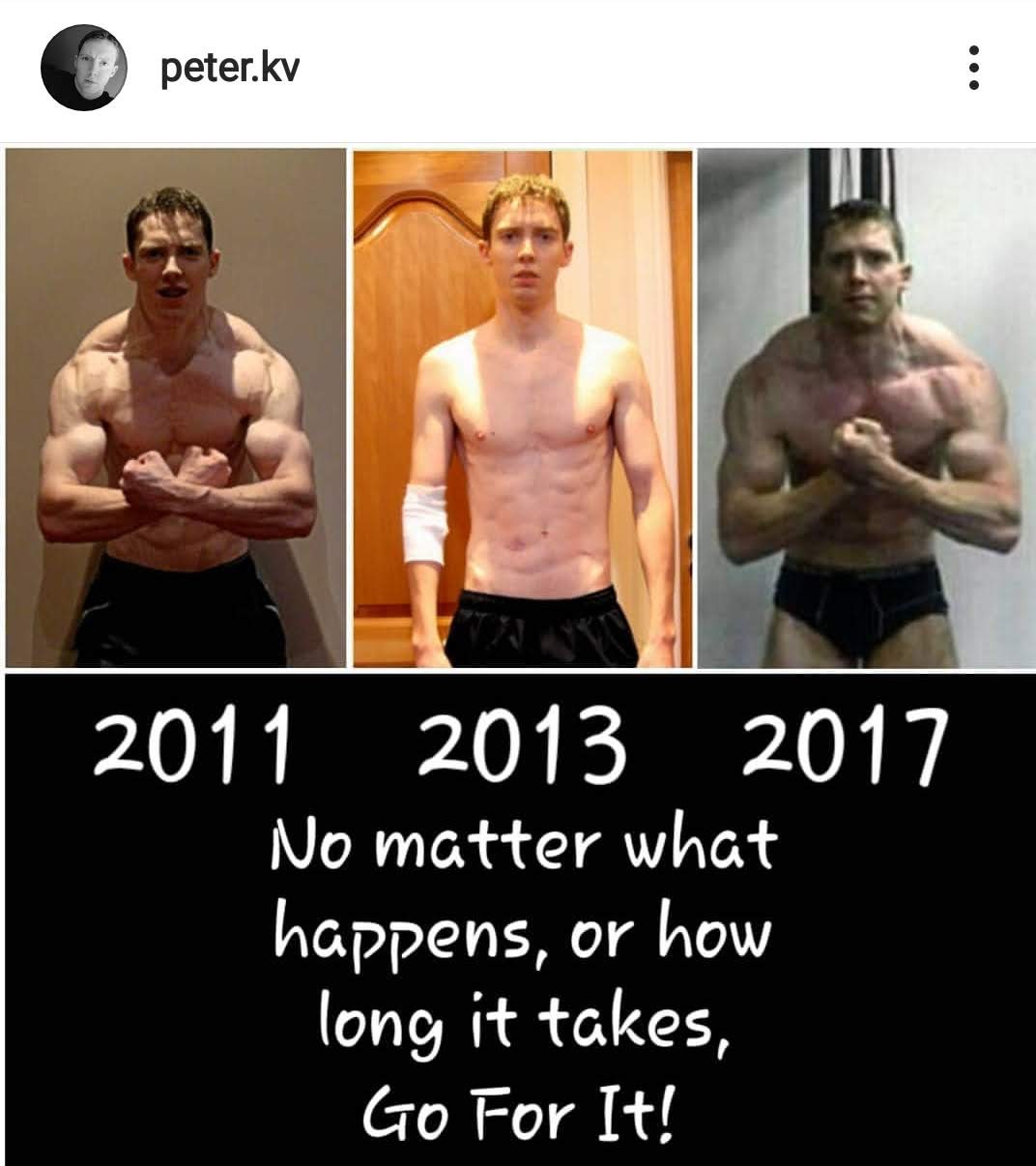
My unobtainable biceps goal as demonstrated by Peter K. Vaughn (find him on Instagram @peter.kv or @pkv.personaltraining).

Genetics determines muscle shape and the ability to build muscle. This doesn’t mean that someone with ordinary genetics can’t build a good looking body. But it’s going to take effort and commitment and frankly you may never look the way you want to look. Despite whatever artificial assistance Arnold had he was in reality a genetic freak (I don’t mean that in a mean way). Even at a young age he was better built than most adult men. His potential was enormous from the start.

My reality. Same size at Peter’s arm above, but due to a different shape and higher amount of body fat not nearly as impressive.

Regardless of genetics if you don’t put in the work and the nutrition, you won’t make outstanding progress as evidenced by this photo of my arm from 2017. A big arm, but soft. Below is a more recent picture of my arm after losing some weight. Shape is the same, but definition is better so the arm at a smaller size actually looks larger.

Me just before my recent surgery. My arm is smaller but better defined. Still no peak though due to the positioning of my muscle insertions and overall shape of the muscle belly.

So given that genetics will partly determine your ultimate results what can you expect if you put the work in? Frankly, quite a bit.

First off, regardless of how you end up looking you will feel better, move better and, barring an underlying medical condition of some kind, be healthier in general.

Even with an underlying health condition chances are you’ll do better with regular exercise than without (always check with your doctor before starting any program). For example, my friend Peter K. Vaughn like me suffers from Crohn’s. But despite multiple setbacks due to the disease he has the drive and stamina to keep making the best of what God gave him. Somewhat thin and lanky by nature he has overcome this to build a solid physique. The proof is in the picture below.

As you can see, he makes tremendous progress between setbacks. His biceps respond the fastest to training, but thanks to his consistency, commitment to proper nutrition, and the wonder of muscle memory, he bounces back quickly.

Even if you have great overall genetics to start with, it still takes time and effort to reach your full potential. Though progress can be noted in a few weeks, real change takes months and often years. For example Alexander Miles below.

Photo courtesy of Alexander Miles on Instagram @milesfitness. His website is
https://myfit-strategy.com/ .

Even as a teen you can see the potential in his physique based on his well defined delts and arms. However, he starts out pretty thin without much chest development or the classic V shape. Today however, you would not know that he was once a skinny teen. By working out regularly, and hard, staying focused on nutrition he’s been able to maximize his physique over a period of years.

Even guys with more average builds to start with can vastly improve their physiques and strength. For example, I used to work with a young man, Aymeric Van De Hove, pictured below, who went from a typical thin teen to a very well built man in less than five years. You can see some of his basic muscle shape in the 2010 photo, but no real hint of the physique that he would ultimately build over the next five years. With hard work and dedication he took what most experts might call an average physique and built something impressive and distinctly above average. Aymeric is also blessed with a very symmetrical physique. Note how his abs line up perfectly with each other. This is more rare than you might think and a product of genetics which cannot be changed regardless of how many crunches you do.

One last observation, “bro science” will tell you that tall men have a harder time putting on muscle than shorter men (think Basketball players versus gymnasts) but in my experience this isn’t necessarily true. I know some tall men who have an impressive amount of muscle on their frames and some skinny short guys. Some of the difference is just a matter of perspective. A 6 foot man with 16 inch arms will look smaller than a 5 foot 5 inch man with the same size arms. But, they actually have the same amount of muscle. And the taller man often has a larger frame and ultimately can put on more muscle than the shorter guy. In any case, both tall and shorter men can build a significant amount of muscle. In my opinion, you are more likely to be limited by the size and width of your frame.

Your height is no barrier to building muscle. Here’s Caleb Carr (@calebcarrfitness on Instagram) who is 5’5″ inches tall. Five years ago he was a lean runner with fairly wide shoulders, note the muscle definition in the before picgture. Already he was showing the potential for growth. Today he’s the same height and 75 pounds heavier (about 205). He’s clearly made the most of his great potential through heavy lifting and proper nutrition.
Likewise, tall men can build muscle too. Here’s me with Davy Barnes at the Arnold a few years ago. Davy, a recent contestant on the Titan Games (@davymichael on Instagram), stands 6’3″ and started working out when he was about 150 pounds. In this picture he weighed about 250 which is not his biggest. Currently, he carries 270 pounds on a relatively wide frame.

So to sum up, there are many factors that go into determining how far you can take your physique. I’ve only discussed a few here and most can be overcome for the most part. But the main takeaway is that regardless of the body nature gives you, you can build a better looking and healthier body. You need to put in the work, stay true to good nutrition, stay consistent in your workouts, and change your lifestyle to make meaningful change. The change will take time as there is no magic pill – but you can do it! Just don’t expect biceps like Arnold. Build the best body you can build, don’t be like me and keep comparing yourself to others or judging your progress by their progress.

We all have different metabolism’s and progress at our own rate. Keep striving to be the best you can be and you’ll be a happy camper indeed.

Onward!

Note: this blog is written from a male perspective because I’m a guy. Motivations and expectations are likely different for women. Just saying. Also, as always, no matter how motivated you feel after reading this blog – and I hope you feel at least a little motivated – always check with your favorite health care provider before starting a new exercise routine.